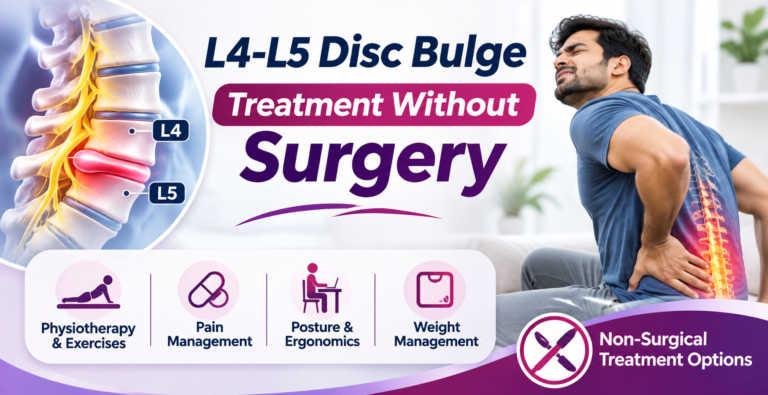
L4-L5 Disc Bulge Treatment Without Surgery: What Works and When to Worry
Medically reviewed by Dr. Tushar Pisal, MS (Orthopaedics), Spine Surgeon, Pune
Quick answer: Most people with an L4-L5 disc bulge get better without surgery. With the right mix of short rest, medicines, physiotherapy and posture changes, back and leg pain usually settles within 6 to 12 weeks. Surgery is considered only when pain does not settle, the leg becomes weak, or there are changes in bladder or bowel control. Those warning signs need urgent medical review.
An MRI report that says “L4-L5 disc bulge” can feel alarming. In reality, disc bulges are very common, and many are found on scans of people who have no pain at all. What matters is not the bulge itself but whether it is pressing on a nerve, how much it affects your daily life, and how it responds to treatment. This guide explains what works, what to avoid, and when to see a spine specialist.
What Is an L4-L5 Disc Bulge?
Your lower back (lumbar spine) has five vertebrae, named L1 to L5. Between each pair sits a soft, rubbery disc that works as a shock absorber. The disc between the 4th and 5th lumbar vertebrae is called the L4-L5 disc. It carries a large share of your body weight and bends the most when you lift, sit or twist, which is why it is one of the two discs most often affected.
A disc bulge means the disc has spread outward beyond its normal edge, usually evenly, like a tyre that is slightly flat. The tough outer wall of the disc is still intact. Bulges often develop slowly with age, long hours of sitting or repeated heavy lifting.
Disc bulge | Disc herniation (slipped disc) | |
What happens | Disc spreads outward evenly | Soft inner gel pushes out through a tear in the outer wall |
Area involved | A wide part of the disc edge | A small, focused part |
Nerve pressure | Often mild or none | More likely to press on a nerve |
Typical symptoms | Back stiffness, mild leg pain, or no pain | Sharper leg pain (sciatica), numbness, tingling |
People often use “slipped disc” for both. A bulge can progress to a herniation, so it is worth treating early. Read more on our [ slipped disc page].
L4-L5 vs L5-S1: The L5-S1 disc sits one level lower, between the last lumbar vertebra and the sacrum. Both levels cause back pain and sciatica, but they usually affect different nerves, so the area of leg pain and numbness differs. The next section explains how.
Symptoms: Back Pain, Sciatica and Numbness
Many L4-L5 bulges cause no symptoms. When they do, symptoms depend on whether the bulge only irritates the disc or also presses on a nerve root.
Common symptoms:
- Low back pain or stiffness, often worse after sitting, bending or lifting
- Pain that travels from the buttock down the leg (sciatica), usually on one side
- Tingling, pins and needles or numbness in part of the leg or foot
- Pain that increases with coughing, sneezing or straining
- Weakness in the foot or toes in more severe cases
An L4-L5 bulge most often presses on the L5 nerve root. An L5-S1 bulge usually affects the S1 nerve root. Your doctor checks the area of pain and the strength in your foot to find out which nerve is involved.
L4-L5 (L5 nerve) | L5-S1 (S1 nerve) | |
Pain and numbness area | Outer thigh, outer side of the lower leg, top of the foot, big toe | Back of the calf, sole of the foot, outer edge of the foot, little toe |
Weakness | Lifting the big toe or the front of the foot; difficulty walking on heels | Pushing the foot down; difficulty standing on tiptoe |
Reflex change | Usually none | Reduced ankle reflex |
Less often, a bulge at the side of the L4-L5 disc presses on the L4 nerve instead, causing pain in the front of the thigh and inner shin. Leg pain from a disc is often called sciatica.
Non-Surgical Treatments for an L4-L5 Disc Bulge
Treatment is usually done in steps, starting with the simplest options. Most patients need only the first two or three.
Treatment | What it involves | Who it helps most |
Short rest and staying active | 1 to 2 days of relative rest, then gentle walking and normal activity as pain allows. Long bed rest slows recovery. | Everyone in the first few days of a flare-up |
Medicines | Pain relievers and anti-inflammatory medicines, muscle relaxants for spasm, and nerve pain medicines for sciatica, as prescribed | Moderate to severe pain that limits sleep, work or walking |
Physiotherapy | Guided exercises to reduce nerve irritation, strengthen the core and improve flexibility, plus heat or other pain-relief methods | Almost all patients once acute pain eases, usually from week 1 to 2 |
Posture and lifestyle changes | Correct sitting and lifting posture, regular breaks from sitting, a supportive chair and mattress, weight management, stopping smoking | Desk workers, drivers and anyone whose pain returns often |
Spinal injections | Epidural steroid injection or selective nerve root block given under image guidance to reduce swelling around the nerve | Strong leg pain that has not improved after 4 to 6 weeks of the steps above |
Do not take painkillers on your own for more than a few days. Some medicines are not safe for people with stomach, kidney or heart problems, so take them only as advised by your doctor.
Injections do not “fix” the bulge, but they calm the inflamed nerve. This often gives enough relief for physiotherapy to work and helps many patients avoid surgery.
Safe Exercises for an L4-L5 Disc Bulge, and Ones to Avoid
Start exercises only after a doctor or physiotherapist has examined you. The right exercises depend on your symptoms, and a movement that helps one person can worsen pain in another.
Exercises that are usually safe:
- Walking: 10 to 20 minutes on flat ground, once or twice a day. One of the best ways to recover.
- Prone lying and press-ups: Lie on your stomach, then slowly push your upper body up on your forearms while keeping the hips down. Often eases leg pain from a bulge.
- Pelvic tilts: Lie on your back with knees bent and gently flatten your lower back against the floor.
- Glute bridge: From the same position, lift your hips to make a straight line from shoulders to knees.
- Bird-dog: On hands and knees, stretch one arm and the opposite leg out, keeping the back level.
- Nerve glides: Gentle movements, taught by a physiotherapist, that help the irritated nerve move freely.
Exercises and activities to avoid in the early weeks:
- Toe touches and other deep forward bending
- Sit-ups and crunches
- Lifting heavy weights, especially from the floor (deadlifts)
- Twisting the spine while carrying weight
- Running, jumping and other high-impact sports
- Yoga poses with deep forward bends, until cleared by your doctor
A simple rule: If pain moves away from your leg toward your back during an exercise, it is usually a good sign. If pain or numbness spreads further down the leg, stop that exercise and tell your physiotherapist.
How Long Does Recovery Take Without Surgery?
Most people with an L4-L5 disc bulge feel clearly better within 6 to 12 weeks of starting treatment. Recovery is rarely a straight line, so a few good days followed by a bad day is normal.
- First 1 to 2 weeks: Sharp pain starts to ease. Short walks and gentle movement become easier.
- Weeks 2 to 6: Leg pain usually reduces before back stiffness does. Physiotherapy and posture correction make the biggest difference here.
- Weeks 6 to 12: Most patients return to normal daily activities. Strengthening continues to prevent the pain from coming back.
- Beyond 3 months: Numbness or tingling can take longer to fade, sometimes several months, because nerves heal slowly.
Recovery may be slower for people who smoke, sit for long hours, are overweight, have diabetes or have had previous episodes of back pain. Desk workers can often return to work within a few days to two weeks with regular breaks. Jobs that involve heavy lifting usually need a longer, gradual return.
If pain is not clearly improving after 6 weeks of proper treatment, see a spine specialist for a review.
Red Flags: When Surgery May Be Needed
Only a small number of people with an L4-L5 disc bulge need surgery. These signs mean you should not wait.
Go to a hospital emergency immediately if you have:
- Loss of bladder or bowel control, or difficulty passing urine
- Numbness in the groin, genitals, inner thighs or around the back passage (saddle area)
- Weakness or numbness in both legs
These can be signs of cauda equina syndrome, a rare but serious condition where the disc presses on a bundle of nerves at the base of the spine. It needs emergency surgery to protect bladder, bowel and leg function.
See a spine specialist within a few days if you have:
- Increasing weakness in the leg or foot, such as foot drop or tripping over your toes
- Severe leg pain that is not controlled by medicines
- Pain that has not improved after 6 to 12 weeks of proper non-surgical treatment
- Back pain with fever, unexplained weight loss, a history of cancer, or after a fall or accident
Endoscopic Spine Surgery, If It Is Needed
When surgery is needed for an L4-L5 disc, many patients are suitable for endoscopic discectomy. The surgeon passes a thin camera through a small cut, usually under 1 cm, and removes only the part of the disc pressing on the nerve.
- Smaller cut and less damage to the back muscles than open surgery
- Often done with a short hospital stay
- Most patients start walking the same or next day
- Return to desk work is often possible within a few weeks, depending on the case
Not every disc problem is suitable for endoscopic surgery. The choice depends on the size and position of the disc, your MRI and your overall health, and is made after a detailed examination.
Frequently Asked Questions About L4-L5 Disc Bulge
Can an L4-L5 disc bulge heal on its own?
The bulge may not fully disappear, but symptoms often settle on their own as nerve inflammation reduces. Many disc bulges also shrink over time. Physiotherapy and posture changes help recovery and reduce the chance of repeat episodes.
Is walking good for an L4-L5 disc bulge?
Yes. Regular walking on flat ground is one of the safest and most helpful activities. Start with short walks and increase the time slowly as pain allows.
What is the best sleeping position for an L4-L5 disc bulge?
Sleep on your back with a pillow under your knees, or on your side with a pillow between your knees. Both positions reduce strain on the lower back. Use a medium-firm mattress.
Do I need an MRI for an L4-L5 disc bulge?
Not always. An MRI is usually advised if pain does not improve after 4 to 6 weeks, if there is leg weakness, or before an injection or surgery. Red-flag symptoms need an urgent MRI.
Can I do yoga with a disc bulge?
Gentle yoga can help once acute pain has settled, but avoid deep forward bends and twists in the early weeks. Ask your doctor or physiotherapist which poses are safe for you.
Can the L4-L5 disc bulge come back?
Yes, pain can return, especially with poor posture, long sitting or heavy lifting. Regular core exercises, a healthy weight and correct lifting technique lower the risk.
When should I see a spine specialist?
See a specialist if pain lasts more than 6 weeks, keeps returning, spreads down the leg, or comes with numbness or weakness. Any red-flag symptom needs urgent care.