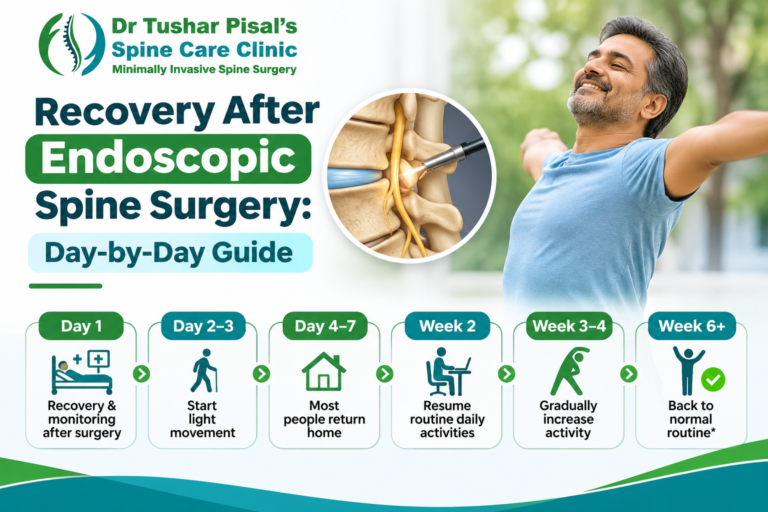
Recovery After Endoscopic Spine Surgery: Day-by-Day Guide
Most patients walk within a few hours of endoscopic spine surgery and go home the same day or the next day. Light daily activities and desk work usually resume within 1 to 2 weeks. Driving is typically allowed after 2 to 3 weeks, and most people return to their full routine, including heavier work, by 6 to 12 weeks. Your own timeline depends on the procedure, your fitness and your surgeon’s advice.
Endoscopic spine surgery uses a small cut, usually under 1 cm, and a thin camera to treat problems such as a slipped disc or a pinched nerve. Because the back muscles are mostly left undisturbed, recovery is usually faster and less painful than after open surgery. This guide explains what to expect at each stage and how to protect your spine while it heals.
Day of Surgery and Discharge
Endoscopic spine surgery is often done under local anaesthesia with sedation, or under general anaesthesia, depending on the procedure. It usually takes about 1 to 2 hours.
After the procedure:
- You rest in the recovery room for a few hours while the anaesthesia wears off.
- Many patients notice that their leg pain is lighter soon after surgery, because the pressure on the nerve has been removed. Some soreness at the wound is normal.
- Under supervision, you get up and walk a few steps, usually within 2 to 4 hours.
- Pain is controlled with tablets. Strong injections are rarely needed.
Before you go home:
- Most patients are discharged the same day or the next morning.
- The wound is covered with a small dressing. Keep it clean and dry as instructed.
- You receive a list of medicines, wound care instructions and a follow-up date, usually after 7 to 14 days to check the wound.
- Arrange for a family member to drive you home. Do not drive yourself.
Some numbness or tingling in the leg can continue for a few weeks after surgery. This is common while the nerve recovers and does not mean the surgery has failed.
Recovery Timeline: Week 1, Weeks 2–4 and Months 1–3
Recovery happens in stages. The table shows what most patients can expect, but your surgeon may adjust it for you.
Stage | What you can do | What to avoid | How you may feel |
Week 1 | Walk 5 to 10 minutes several times a day, light self-care, short spells of sitting (20 to 30 minutes) | Lifting, bending, twisting, driving, long sitting | Wound soreness; leg pain much less than before surgery |
Weeks 2–4 | Longer walks, desk work from home or office, short car rides as a passenger, start physiotherapy | Lifting more than 2 to 3 kg, sports, gym, floor sitting | Energy improving; some stiffness and occasional nerve tingling |
Months 1–3 | Driving, office travel, guided strengthening exercises, gradual return to physical work and light sports | Heavy lifting and high-impact activities until cleared | Most daily activities feel normal; strength keeps improving |
After 3 months | Most patients are back to their full routine, including gym and sports, as advised | Poor lifting habits that strain the spine again | Healing largely complete; numbness may take longer to settle |
When Can You Walk, Sit, Drive, Ride a Two-Wheeler and Travel?
These are typical timelines after an uncomplicated endoscopic discectomy. Always follow your surgeon’s advice for your case.
Activity | Usually allowed from | Tips |
Walking | Same day | Start with short walks and increase a little each day |
Sitting | Day 1, for 20 to 30 minutes at a time | Use a chair with back support; stand up and walk every 30 minutes |
Climbing stairs | Day 1 to 2 | Hold the railing and go slowly |
Driving a car | 2 to 3 weeks | Only when you are off strong painkillers and can brake quickly without pain |
Riding a two-wheeler | 4 to 6 weeks | Potholes and jerks strain the spine; avoid long rides and rough roads at first |
Sitting as a car passenger | 1 week, short trips | Recline the seat slightly and take breaks |
Train or flight travel | 2 to 4 weeks | Choose an aisle seat, walk every hour, and do not lift heavy luggage |
Two-wheelers are a common concern in Indian cities. The vibration and sudden jerks on bumpy roads put more strain on the healing disc than a car does, so most surgeons advise waiting longer before riding.
Returning to Desk Work vs Physical Work
When you can go back to work depends mostly on what your job involves.
Type of work | Examples | Typical return |
Desk or computer work | IT, banking, office, teaching | 1 to 2 weeks; work from home earlier if possible |
Light physical work | Retail, nursing, field sales | 3 to 6 weeks |
Heavy physical work | Construction, loading, factory, farming | 6 to 12 weeks, after strengthening and surgeon clearance |
Tips for desk workers
- Set a reminder to stand up and walk for a few minutes every 30 to 45 minutes.
- Keep the screen at eye level and your feet flat on the floor.
- Use a small cushion or rolled towel to support your lower back.
- Start with half days if your office allows it.
For physical jobs, return in steps: light duties first, then gradually heavier tasks. Ask your surgeon for a fitness letter if your employer needs one.
Physiotherapy and Exercises After Surgery
Surgery removes the pressure on the nerve, but physiotherapy rebuilds the strength that protects your spine. It also lowers the chance of the disc problem coming back.
- Weeks 1–2: Walking and gentle movement. Walking is the main exercise. Your physiotherapist may add ankle pumps, deep breathing and gentle tightening of the stomach muscles while lying down.
- Weeks 2–6: Core activation. Pelvic tilts, gentle glute bridges, and lying leg slides teach the deep core muscles to support the spine. Nerve glides help the healed nerve move freely.
- Weeks 6–12: Strengthening. Bird-dog, side planks on the knees, wall squats and exercise-ball work build endurance in the back and hips. Stationary cycling and swimming can be added when the wound has fully healed.
- After 3 months: Return to fitness. Gym training, yoga and sports can be resumed gradually with correct technique.
Do every exercise slowly and without pain. Mild muscle tiredness is normal, but sharp pain or pain spreading down the leg means you should stop and inform your physiotherapist.
Do's and Don'ts After Endoscopic Spine Surgery
Do | Don’t | |
Lifting | Keep objects close to your body and bend your knees, not your back | Lift more than 2 to 3 kg for the first 4 weeks, or heavy loads for 6 to 12 weeks |
Bending | Squat or kneel on one knee to pick things up | Bend forward from the waist to touch the floor |
Floor sitting | Use a chair, dining table and Western toilet for the first 4 to 6 weeks | Sit cross-legged on the floor or use an Indian-style toilet early on |
Sleeping | Sleep on your back with a pillow under the knees, or on your side with a pillow between the knees | Sleep on a sagging mattress or on your stomach |
Getting out of bed | Roll onto your side, then push up with your arms (log-roll) | Sit straight up from lying flat |
Wound care | Keep the dressing dry; shower only when allowed | Soak in a bath or swim until the wound fully heals |
Lifestyle | Eat a balanced diet, drink plenty of water, stay active | Smoke, as it slows disc and wound healing |
Floor sitting, Indian-style toilets and bending to tie shoelaces are common daily habits that strain the lower back. Small changes at home in the first few weeks protect the healing disc.
Warning Signs: When to Call Your Surgeon
Complications after endoscopic spine surgery are uncommon, but it is important to recognise them early.
Go to the hospital emergency immediately if you have:
- Loss of bladder or bowel control, or difficulty passing urine
- New numbness in the groin, genitals or inner thighs
- Sudden weakness in one or both legs
Call your surgeon the same day if you notice:
- Fever above 100.4°F (38°C), or chills
- Redness, swelling, warmth or pus at the wound
- Clear, watery fluid leaking from the wound or a severe headache when sitting up
- Leg pain that returns suddenly and strongly after it had improved
- Pain, swelling or redness in the calf, or sudden breathlessness
Mild back soreness, tiredness and some tingling in the leg in the first few weeks are normal. If you are unsure, it is always better to call.
Endoscopic vs Open Spine Surgery: Recovery Compared
Both approaches aim to free the trapped nerve. The main difference is how much tissue is disturbed to reach it, which affects recovery.
Endoscopic surgery | Open surgery | |
Cut size | Usually under 1 cm | Usually 3 to 5 cm or more |
Muscle disturbance | Muscles gently moved aside | Muscles cut or stripped from the bone |
Anaesthesia | Often local with sedation, or general | Usually general |
Hospital stay | Same day to 1 night | Usually 2 to 4 days |
Walking after surgery | Within a few hours | Usually from the next day |
Pain after surgery | Usually mild | Usually moderate |
Return to desk work | 1 to 2 weeks | 4 to 6 weeks |
Scar | Very small | Longer |
Endoscopic surgery is not suitable for every spine problem. Large or complex disc herniations, spinal instability or multiple levels may need another approach. Your surgeon recommends the option that is safest for your condition.
Frequently Asked Questions
How long does it take to fully recover from endoscopic spine surgery?
Most patients return to normal daily activities within 2 to 6 weeks and to their full routine, including heavier work and sports, by about 3 months. Numbness can take longer to settle.
How long should I rest after surgery?
Complete bed rest is not needed. You are encouraged to walk on the day of surgery. Rest when tired, but avoid lying in bed for long periods, as gentle movement speeds up healing.
When will the stitches be removed?
If non-absorbable stitches are used, they are usually removed at the follow-up visit after 7 to 14 days. Absorbable stitches do not need removal.
Will I need a belt after surgery?
Many patients do not need one. Some surgeons advise a lumbar belt for short periods, such as during travel, in the first few weeks. Use it only as advised.
Can the disc slip again after surgery?
There is a small risk of the disc herniating again at the same level, most often in the first few months. Following lifting precautions, doing your exercises and keeping a healthy weight lower this risk.
Can I sit on the floor or use an Indian toilet?
It is best to avoid floor sitting and Indian-style toilets for the first 4 to 6 weeks. Use a chair and a Western toilet or a commode chair until your surgeon allows it.
When can I start going to the gym?
Light cardio such as walking or stationary cycling can usually start after 4 to 6 weeks. Weight training and sports are generally resumed after about 3 months, once your surgeon and physiotherapist agree.